
Hunucmá
Things to do in Hunucmá, Yucatán
Hunucmá is where western Yucatán keeps its paperwork, its market and — most of the year — one of the peninsula’s most travelled sacred images. This is the municipal seat: 28,412 people in the town, 35,137 across the municipality (2020), some 30 km west of Mérida by road. It is not a Pueblo Mágico, and this page will never call it one — the municipality holds that designation only through Sisal, its port locality about 24 km north, which is a separate town with its own record. What the seat has is rarer than a label: the Cristo Negro lives in its parish church most of the year, the Virgen de Tetiz comes visiting every winter and the town’s great feria is built around her stay, the June Enramada fills the churchyard with harvest offerings, and the daily food market — unusual for a town this size — actually publishes its hours. Come for the seat that runs the municipality; this page keeps its layers straight.
Photos of Hunucmá
Rights-cleared photos from Wikimedia Commons.
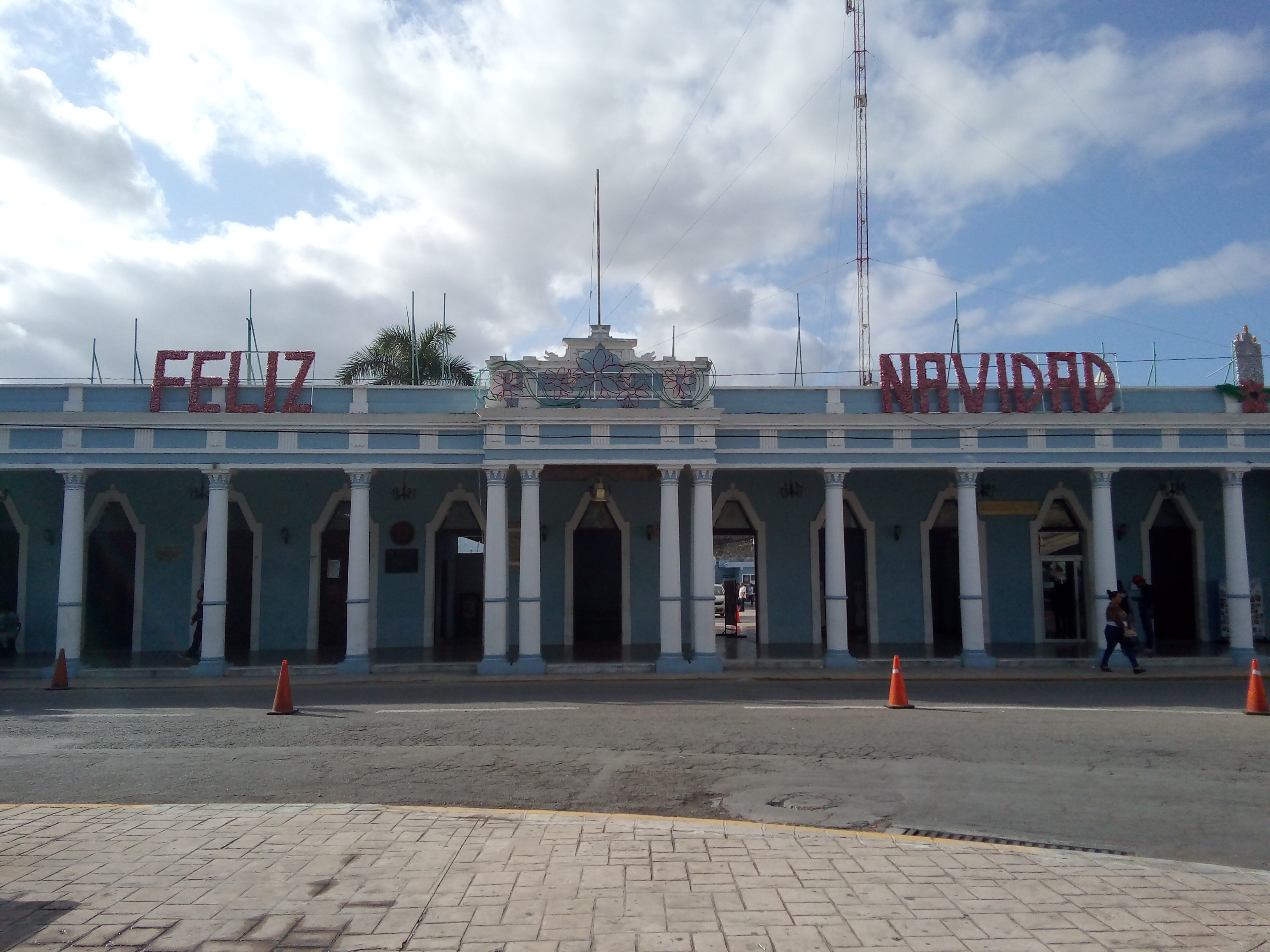
A working seat: the plaza, the palacio and the clock
Everything that makes Hunucmá the seat stands around one square. The Plaza Principal gathers the parish church, the Palacio Municipal — a 1930s neo-Maya building raised on the site of an older casona — and the historic market building whose facade carries a German public clock inaugurated in 1906. The municipality the seat administers is bigger than the town: its comisarías include Sisal on the coast, Texán de Palomeque, Huncanab and San Antonio Chel. Around the square sit the town’s daily machinery — the Ayuntamiento, the markets, the bus terminal for Mérida — and the feria grounds, the Explanada San Pool with its concha acústica, lie a short walk away. Plan a visit as the locals use the town: mornings at the market, the plaza in the evening, and the calendar’s great dates circled in January–February and June.
San Francisco de Asís: the parish, the patron — and no feria
The parish church on the plaza is the Parroquia de San Francisco de Asís, a 16th-century ex-convent church per the state profile, at C. 30 x 31 in the Centro. Read its dedications in layers, because Hunucmá punishes guides that flatten them. The parish is dedicated to San Francisco de Asís, whom directories call the town’s patron saint — but no Hunucmá feria for San Francisco was found in any source, and we invent none: his 4 October feast surfaces here at parish weight only. The state profile separately lists a temple to Santiago Apóstol (17th century) and chapels to San Antonio and Guadalupe — distinct buildings, none of them the parish, none of them the patronal. And the town’s actual patronal feria honours neither saint: it belongs to a visiting image, two sections down. No parish-published mass schedule exists — secondary directories agree on a 19:30 weekday mass but conflict on Sunday mornings — so no timetable is printed here; ask at the parish.
The Cristo Negro lives here
Ask where the Cristo Negro — the Señor de Sisal — lives, and the honest answer surprises most visitors: here. With no church in Sisal in the early period, the image was brought to Hunucmá, and it is kept in the Parroquia de San Francisco de Asís most of the year — a custody a diocesan inventory already records in 1853. Hunucmá’s custodios hold it under a long-standing permission tradition, and each year in early August the image leaves its home church for its temporada in Sisal’s Capilla de San José, where the port’s own fiesta season — already recorded on Sisal’s pages — runs to the last Sunday of the month. So the story splits cleanly in two: the keeping and the departure are Hunucmá’s; the August fiesta itself is Sisal’s, and this page tells the home side without duplicating the port’s fixture.
The winter feria: when the Virgen de Tetiz comes to stay
Hunucmá’s fiesta mayor is a visit. The Virgen de la Asunción de Tetiz — whose home is Tetiz, a separate municipality some 8.5 km south — is carried to Hunucmá each winter and stays about fifteen days of gremio entries and parish acts, and the municipal Feria / Expo Feria is held in her honour. The dated record shows the shape: in January 2023 the image arrived on a Sunday and was crowned in the parish church; a feria listing gives Feria Hunucmá 2026, 4–9 February, in her honour, with dance, vaquería and jaripeo nights; and the Expo Feria’s form, from its 2015 edition, is an inauguration at the Explanada San Pool, the embajadora’s coronation at the concha acústica, artisan, gastronomy and footwear exhibitions, and a closing magna vaquería. Two honest warnings. The feria’s dates move — the state profile ties them to the Carnaval–Cuaresma cycle — so no 2027 dates exist yet: the parish and Ayuntamiento announce the cycle each January, and that announcement governs. And the devotional stay runs longer than the fairground programme; the two layers are not the same thing.
La Enramada: Corpus Christi in June, the town's signature custom
If the winter feria belongs to a guest, the summer one is Hunucmá’s own. For Corpus Christi the town raises an enramada in the atrio of San Francisco de Asís: a wooden ramada displaying the harvest’s offerings — fruit, breads, sweets, crafts — with an altar at each corner for the four cardinal points, blessed through masses and processions with the Santísimo, gremios taking part, the Toro de Fuego burned at night during the cycle and La Boxita burned on the Sunday after morning mass. The dated evidence puts the season firmly in June: local records give ramadas 3–11 June and a vaquería on 6 June 2026, around the feast itself (Thursday 4 June 2026). One conflict, stated plainly: the state profile prints a ‘28–31 January Corpus Christi’ line for Hunucmá that no dated source supports and that a movable June feast cannot fit — we flag it as an error in the profile and print the June season, which is what the town actually lives.
Two markets: the food market that publishes hours, and the clock building that is now a bazar
Hunucmá has two market buildings a few streets apart, and telling them apart is the town’s easiest test. The working food market is the Mercado Municipal de Hunucmá (C. 26A 15, Centro) — and here Hunucmá breaks the small-town pattern: it publishes hours, daily 05:00–15:00 on its place record (a directory variant gives 06:00 as the opening; the variant is flagged, never hidden). Press colour backs the record: a fruit-and-vegetable washing area, a seafood vendor, produce left overnight in crates on the west sidewalk — a real centro de abasto feeding the town every morning. The second building, the Mercado Eulogio Rosado on the plaza (C. 29), is the historic one — the 1906 clock building — but it was outgrown as the food market years ago and today trades as a bazar of shoe, clothing and artisan shops (place-record hours 09:00–17:00). Its 2026 story is maintenance, not loss: the Ayuntamiento’s 2026 gazette authorises a rehabilitation of MXN 301,600 — a refurbishment of a historic building. No demolition, no closure, no relocation is reported for either building, and any guide telling you otherwise has confused this town with another.
Two culture houses, kept distinct: Yol-Izma and the Casa de la Cultura
Hunucmá has two cultural operators, and they are not the same institution wearing two names. The Centro Cultural Yol-Izma (C. 34A No. 255, Col. Álvaro Obregón) is an independent centre, listed in the federal cultural information system, with its own theatre of about 180 seats built up over more than twenty years — a venue for state cultural seasons and theatre gatherings. The Casa de la Cultura is the municipal one, run through the Ayuntamiento’s education and culture office, with courses documented in press and state reactivation lists — but it has no federal cultural-centre ficha and publishes no programme or hours, so none are invented here. Neither operator publishes a calendar; when either does, this page will carry it with its source.
Library, bachillerato and the university that isn't here
The seat’s library outranks its port’s: the Biblioteca Pública ‘José León Bojórquez García’ (C. 25 s/n x 16, Centro Comunitario Flores Magón) is a Regional-type library, number 1334 in the federal network — Hunucmá’s number; Sisal’s is 2011, and the two are never cross-wired here. Its federal ficha gives Monday–Friday 08:00–20:00 and lists home lending; the namesake is the Hunucmá-born composer the library is named for. Secondary schooling is deep for a town of 28,000: the COBAY Plantel Hunucmá (federal clave 31ECB0040L) and the CECyTEY Plantel 02 (31ETC0002Y) both stand in town, alongside private prepas and an adult-education CEBA module. But there is no university in Hunucmá — the state higher-education census lists none, in either cycle checked — and this page claims none. The nearest campus is the Universidad Politécnica de Yucatán at Ucú, some 13 km east: a labelled proximity, never a Hunucmá institution.
Sisal: the town's own beach, a separate town
Every seat needs its coast, and Hunucmá’s is Sisal — its port locality, about 23.6 km north as the crow flies and 24.1 km by road (about 26 minutes; a direct Oriente bus runs the corridor). Sisal is close enough to feel like Hunucmá’s beach and separate enough to be its own town: it holds the municipality’s Pueblo Mágico designation (December 2020), its own library, its own malecón and its own August fiesta for the Cristo Negro that lives here in Hunucmá the rest of the year. Hunucmá pages present Sisal honestly — as the town’s port layer, with its own full Dayfari record — and never borrow its designation or its fixtures.
Heritage at the edges: Xcopte and the exhaciendas
The state profile names Maya vestiges at Xcopte and the exhaciendas Santa Elena, San Joaquín and Chencopo. Read those names exactly as far as the evidence goes: Xcopte has no INAH open-zone listing — no entrance, no hours, no fee exist, and none is printed here — and the exhaciendas are heritage leads with no verified visitor schedule. There is likewise no museum in town in any registry checked: an honest absence, not a gap to fill with invention.
Everyday Hunucmá: softball fields, the sports unit and the UBR
The living municipal sport is softball and baseball: the town’s grounds include the Campo de Soft-Ball Ramón Ortíz Ceballos and the Campo de Béisbol Silverio Pat Chi, the Polifuncional in Colonia Itzimná and the Unidad Deportiva — real grounds whose leagues publish no fixture lists, so none are printed (a visiting women’s softball exhibition by the Amazonas de Yaxunah in March 2023 shows the level of the local game). The state-circuit record is equally honest: no current Hunucmá club plays in the state leagues checked, though the Mayas de Hunucmá fielded a third-division side in 2020–22. For services, the seat carries what Sisal travels here for: the UBR Hunucmá rehabilitation unit sits in town beside the IMSS at the town entrance, 07:00–14:00 on the official state directory, and the DIF Municipal is the first contact for family services.
Getting here, and when to come
Hunucmá faces Mérida, and the numbers need care: the road distance is 29.8 km (about 29 minutes by car) — the ‘Km 25’ figure you will see quoted is the highway marker at the COBAY plantel on the town’s east edge, not the distance, and Mérida’s centre sits just outside this town’s 25 km study radius. A direct Oriente bus runs Hunucmá ↔ Mérida Noreste roughly hourly in about 40 minutes (fares in the 21–55 peso range on routing listings; confirm at the terminal). For trains, the nearest Tren Maya station is Umán, 22.4 km away straight-line — not Mérida’s Teya station, which is nearly twice as far from here. West and north, the day trips are Sisal (24.1 km) and Celestún (62.4 km via Kinchil, with a direct bus). When: January–February for the Tetiz stay and the feria; June for La Enramada; early August to see the Cristo Negro’s home before its Sisal temporada; 1–2 November for Hanal Pixán kept at home altars.
Explore by interest
The full set of Hunucmá guides is being built family by family by the town crew, all from places and events researched in October 2026. Start with the guides below and check back as more go live:
All Hunucmá guides
ItinerariesFitnessNightlifeRestaurantsBrunchCoffee shopsCulture & shoppingWalking & hikingDay tripsHidden gemsIndoor activitiesFree things to doDate ideasSolo travelTeen activitiesThings to do at nightTennisBeauty & wellnessPetsKids activitiesClasses & workshopsFarmers marketsLive musicCocktail barsRooftop bars
Common questions
Is Hunucmá a Pueblo Mágico?
No - not the town. The state's own tourism reporting lists Yucatán's seven Pueblos Mágicos as Izamal, Valladolid, Maní, Motul, Tekax, Espita and Sisal. Hunucmá municipality holds the designation only through Sisal, its port locality about 24 km north, which is a separate town. Hunucmá the seat is a working municipal capital with its own feria, its own market and the Cristo Negro's home church - it does not need a borrowed label.
What is Hunucmá's biggest festival?
The winter Feria / Expo Feria built around the stay of the Virgen de la Asunción de Tetiz, a visiting image whose home is Tetiz, 8.5 km south. She stays about fifteen days of gremio acts in January-February while the fair runs at the Explanada San Pool - a feria listing gives February 4-9, 2026 for the fair. The dates move with the Carnaval-Lent cycle, so the next edition is announced by the parish and Ayuntamiento each January; no fixed window exists.
Where does the Cristo Negro live?
In Hunucmá. The image known as the Señor de Sisal is kept in the Parroquia de San Francisco de Asís most of the year - a diocesan inventory records it here in 1853 - and leaves in early August for its temporada in Sisal's Capilla de San José, where the port's fiesta runs to the last Sunday of August. Hunucmá is the keeping town; Sisal owns the fiesta.
When is Corpus Christi in Hunucmá?
In June. The town's signature custom, La Enramada, raises harvest-offering ramadas in the parish atrio around the movable Corpus Christi feast - dated evidence gives ramadas June 3-11 and a vaquería on June 6, 2026. The state profile's 'January 28-31 Corpus Christi' line conflicts with every dated source and is flagged on our pages as an error, never printed as the town's season.
What are Hunucmá's market hours?
The Mercado Municipal de Hunucmá (C. 26A 15) publishes daily hours of 05:00-15:00 on its place record; a directory variant lists a 06:00 opening, which we flag rather than hide. The historic Eulogio Rosado building on the plaza is a different place - today a shoe, clothing and artisan bazar (09:00-17:00 on its record) with a modest MXN 301,600 rehabilitation authorised for 2026 - a refurbishment, not a closure.
Is there a university in Hunucmá?
No. The state higher-education census lists no institution in Hunucmá in either cycle checked. What the town does have is a full bachillerato layer - COBAY Plantel Hunucmá (clave 31ECB0040L) and CECyTEY Plantel 02 (31ETC0002Y). The nearest university campus is the UPY at Ucú, about 13 km east - a proximity, not a Hunucmá institution.
More to explore in Hunucmá
Photos from Wikimedia Commons: The parish church of San Francisco de Asís, Hunucmá, The Palacio Municipal de Hunucmá.


If you book through these links, Dayfari may earn a commission at no extra cost to you.